Specification for the implementation of Zero-Knowledge Proofs based on multi-message signatures in the EUDI Wallet
Note
This technical specification contains exploratory work aimed at clarifying the technical considerations and outlining an approach for integrating zero-knowledge proofs based on multi-message signatures in the EUDI wallet ecosystem. It is not intended to be a final specification. Instead, it will be handed over to ETSI for further refinement, consolidation and formal standardization. In particular, the continued development of this specification is expected to take place under ETSI TS 119 476-2, where the detailed technical requirements and normative provisions will be fully defined.
Licensing and Reuse
© European Union, 2025-2026.
This document is made available under the Creative Commons Attribution 4.0 International licence (CC BY 4.0), unless otherwise stated.
You may reuse this document provided that appropriate credit is given and any changes are indicated.
The full licence text is available at: https://creativecommons.org/licenses/by/4.0/
Version
| Version | Date | Description |
|---|---|---|
0.1 | 2025-12-19 | Initial version |
0.2 | 2026-01-22 | Updates based on first focus group meeting and additional details |
0.3 | 2026-01-30 | Updates based on second focus group meeting, editorial changes and additional explanations |
0.4 | 2026-02-11 | Editorial update (licensing and reuse clarification) |
1.0 | 2026-02-27 | Editorial changes |
1 Introduction and Overview
Multi-Message-Signature (MMS) schemes are a class of signature schemes that allows signing of multiple messages at once. Many MMS schemes are particularly friendly to Zero Knowledge Proof (ZKP) techniques, making them interesting in an EUDI wallet ecosystem context. On the other hand, MMS schemes are relatively immature (when compared to more established digital signature schemes) and so require more effort to integrate into a digital ecosystem.
1.1 ZKPs in [European Digital Identity Regulation]
Regulation (EU) 2024/1183 of the European Parliament and of the Council of 11 April 2024 amending Regulation (EU) No 910/2014 as regards establishing the European Digital Identity Framework [European Digital Identity Regulation], Recital 14, discusses the use of privacy-preserving technologies, such as zero knowledge proof:
Member States should integrate different privacy-preserving technologies, such as zero knowledge proof, into the European Digital Identity Wallet. Those cryptographic methods should allow a relying party to validate whether a given statement based on the person’s identification data and attestation of attributes is true, without revealing any data on which that statement is based, thereby preserving the privacy of the user.
Similarly, Recital 15 of [European Digital Identity Regulation] mentions:
All Union citizens [...] should be empowered to securely request, select, combine, store, delete, share and present data related to their identity [...] while enabling selective disclosure of personal data
Recital 59 of [European Digital Identity Regulation] provides the following definition and requirements for selective disclosure:
Selective disclosure is a concept empowering the owner of data to disclose only certain parts of a larger data set, in order for the receiving entity to obtain only such information as is necessary for the provision of a service requested by a user. The European Digital Identity Wallet should technically enable the selective disclosure of attributes to relying parties. It should be technically possible for the user to selectively disclose attributes, including from multiple, distinct electronic attestations, and to combine and present them seamlessly to relying parties. This feature should become a basic design feature of European Digital Identity Wallets, thereby reinforcing convenience and the protection of personal data, including data minimisation.
Furthermore, Article 5a, 16 of [European Digital Identity Regulation] mandates for "the technical framework of the European Digital Identity Wallet" to:
(a) not allow providers of electronic attestations of attributes or any other party, after the issuance of the attestation of attributes, to obtain data that allows transactions or user behaviour to be tracked, linked or correlated, or knowledge of transactions or user behaviour to be otherwise obtained, unless explicitly authorised by the user; (b) enable privacy preserving techniques which ensure unlinkability, where the attestation of attributes does not require the identification of the user.
Finally, article 11a.2 of [European Digital Identity Regulation] mandates that:
Member States shall provide for technical and organisational measures to ensure a high level of protection of personal data used for identity matching and to prevent the profiling of users.
1.2 Document structure
This document is structured as follows:
- Section 2 outlines the scope of this specification, and in particular which high-level requirements are treated, and which are not.
- Section 3 presents a modular architecture for ZKPs based on MMSs.
- Section 4 provides an overview of different MMS schemes, their pros and cons. Based on this overview, a recommendation is made for integrating MMS schemes in the short and long-term.
- Section 5 provides an overview of instantiations of additional modules needed to fulfill the high-level requirements as well as make recommendations for concrete instantiations of the modules.
- Section 6 discusses issuance of attestations based on MMS schemes.
- Section 7 discusses presentation protocol designs.
- Section 8 discusses data model and container format.
- Section 9 provides an overview of different options for revocation. Based on this overview a recommendation is made for revocation.
2 Scope
This document follows up on the TS-4 - Specification for ZKP Implementation in EUDI Wallet and complements TS-13 - Specification for the implementation of Zero-Knowledge Proofs based on arithmetic circuits in the EUDI Wallet to provide an alternative path to incorporating ZKPs into the EUDI ecosystem. That is, this document includes two things:
- An assessment of options for incorporating ZKPs based on MMSs.
- Based on the assessment, a concrete set of recommendations for integrating a ZK presentation of an attestation using a MMS scheme in the EUDI ecosystem.
Mandatory high-level requirements that are labeled with SHALL or MUST from Section A.2.3.21. Topic 53 of Annex 2 are generally considered to be in-scope, with some exceptions as noted. That being said, Sections 2.1 and 2.2 will explicitly list the requirements considered to be in scope, respectively out of scope, for this Technical Specification. Finally, Section 2.3 elaborates on the relationship between an electronic identification (eID) means at level of assurance (LoA) high and ZKPs as envisioned in the EUDI Wallet ecosystem.
2.1 In scope
- ZKP_01, with the exception of hiding the PID Provider or Attestation Provider. Specifically:
- (i): Proving possession of a PID or attestation, while hiding some or all of its attributes.
- (ii): Proving possession of a PID or attestation within its validity period.
- (iii): Proving possession of a PID or attestation that has not been revoked.
- (iv): Proving that PID or device-bound attestation is bound to a key stored in the WSCA/WSCD or in a keystore of the Wallet Unit.
- ZKP_02: Proving that an attestation has a given type.
- ZKP_03: Proving, in addition to ZKP_01, that an attestation is bound to a PID.
- ZKP_07: The ZKP mechanism must not introduce any additional communication or information that could be used to track or link User activity during, before, or after proof generation.
- ZKP_09: A ZKP scheme must not prevent a User's ability to authenticate at Level of Assurance (LoA) High (see Section 2.3).
2.2 Out of scope
High-level requirements out of scope:
- ZKP_01(v): Hiding the Issuer of an attestation.
This requirement is non-mandatory from ZKP_01 and hence out of scope for this specification.
- ZKP_04: Pseudonyms.
This requirement is not mandatory and out of scope for this specification.
- ZKP_05: Proximity based flows.
This requirement is mandatory but out of scope for this specification to match the scope of TS13.
- ZKP_06: Generating ZKPs based upon mdocs and SD-JWT VCs.
This requirement is not mandatory and, further, it is not possible to use these effectively for ZKPs based on MMSs. Hence, this requirement is out of scope for this specification (see Section 2.4).
- ZKP_08: Only use of standardized algorithms.
The goal of this specification is to provide guidance for what algorithms to standardize in order to enable ZKPs based on MMS schemes in the EUDI ecosystem. The specification will, however, take into consideration the extent to which a particular algorithm relies on already standardized algorithms.
Other explicitly excluded topics:
- Presentations combining different attestations.
This requirement is not mentioned in the HLRs for ZKPs.
- Parameters for instantiations of cryptographic schemes.
Deciding on concrete parameters choices are not in scope. However, the specification will consider the feasibility and options there exist for the considered schemes in order to reach a standard (say 128 bits) level of security.
- Investigation of intellectual property considerations related to cryptographic schemes referenced in this document.
At the time of publication, the authors are unaware of any patents that would necessarily be infringed by implementing the recommendations herein. This statement does not constitute a legal opinion or guarantee. However, no explicit intellectual property investigation has been conducted as part of this work.
2.3 eID means at LoA High and ZKPs
By Article 3 1-5 of the [European Digital Identity Regulation], an eID means is something that enables the confirmation of person identification data that uniquely represents a natural or legal person. Such an eID means has a level of assurance associated with it which by Article 5a 5d of [European Digital Identity Regulation] shall be high as defined in [CIR 2015/1502] for EUDI Wallets. As this data uniquely identifies the person, it does not make sense to talk about unlinkability of an eID means by itself. However, allowing Relying Parties to obtain only partial information from an eID means can be valuable in privacy sensitive use cases. Specifically, ZKPs can be used to prove statements about an eID means without identifying the User. This can for example be used for age verification, where the Relying Party is given a proof that the PID of the User contains an attribute showing that the User is above a certain age, but without revealing either the exact age or the identity of the User. In such cases, the Relying Party can rely on many of the underlying guarantees provided by the LoA High eID means (i.e., how it was issued and guaranteed protected by the User) while ensuring that the User remains completely untraceable (i.e., there are no fixed signature values or any other unique points for correlation that are part of the presentation of the proof). Hence, rather than enabling "ZKPs at LoA High" the goal of this specification is to enable ZKPs (based on MMSs) to be based upon an eID means at LoA High and thereby enable ZKP_09.
In relation to ZKPs based on MMSs over eID means at LoA high there are two central requirements for reaching LoA High in [CIR 2015/1502]:
- The eID means must protect against duplication and tampering as well as against attackers with high attack potential [Section 2.2.1 of CIR 2015/1502].
- Sensitive cryptographic material, if used for issuing electronic identification means and authentication is protected from tampering [Section 2.4.6 of CIR 2015/1502]. Note, this requirement also applies for LoA Substantial.
For the purpose of this document the first requirement is interpreted to mean that presentations must be bound to certified hardware known as a WSCD. The second requirement is interpreted to mean that PID Providers and Attestation Providers must be able to store the cryptographic keys necessary for issuance of attestations and revocation of attestations in certified hardware also. We will make it explicit in the document when a technical mechanism's primary purpose is to fulfill these requirements as providing ZKPs of eID means at lower level of assurances may also provide value in the EUDI ecosystem.
2.4 Incompatibility of mdocs/SD-JWT VCs and ZKPs based on MMSs
Mdoc (ISO 18013-5) and SD‑JWT VCs (selective-disclosure JWT-based verifiable credentials) formats were not designed around the multi-message signing model that MMS-based ZKPs require. Hence, several practical and privacy-relevant mismatches make a direct reuse impractical without substantial changes to those formats. Below the core reasons for this are listed:
- Signature model mismatch: mdocs and SD‑JWTs are built around a single signature over a serialized credential. ZKPs based on MMS rely on signatures over a vector of individually addressable messages (indexed messages) so that the Holder can prove knowledge of a signature while selectively disclosing attributes. Mapping a single-signature credential into the multi-message abstraction requires transformation layers that change where and how attributes are represented and signed.
- Granularity and encoding mismatch: mdocs and SD‑JWTs encode attributes as nested CBOR/JSON structures or as digests, not as a stable ordered list of discrete messages with fixed indices. Efficient MMS proofs (and the sub-proofs in the modular architecture) require a well-defined mapping from attributes to message indices and, in some instantiations, preservation of original scalar inputs (e.g., for range proofs).
- Selective-disclosure semantics differ: SD‑JWT and mdocs uses digest-based selective disclosure, whereas MMS-based presentations use cryptographic re-randomization and committed disclosure patterns. The semantics are built into both SD-JWTS and mdocs.
Because addressing these incompatibilities requires format-level changes, canonicalization rules, or additional transformation layers that would leave only very little of the original specifications, this specification does not try to do so as recommended by ZKP_06. Instead, it provides directions for an alternative format designed for ZKPs based on MMSs.
3 Overview of ZKPs based on MMS Schemes
Multi Message Signatures (MMS) are digital signature schemes characterized by two properties:
- they allow the signer to sign tuples of messages of a fixed length $
(m_1,\ldots,m_n)$ in a single signature $\sigma$ - they support efficient Zero Knowledge Proofs of knowledge of a signature $
\sigma$ and of the attributes signed in it $(m_1,\ldots,m_n)$ while possibly selectively disclosing some of them.
The use of MMS in designing privacy-preserving digital credentials, that in this document will be referred to as attestations, is driven by the security guarantees provided through the following two workflows:
-
Issuance: An Issuer using the key pair $
(isk,ipk)$ can issue an attestation by signing with a MMS scheme the attributes $(m_1,\ldots,m_n)$ it wants to include in it, producing the signature $Sign(isk,(m_1,\dots,m_n))=\sigma$. The attestation is defined as $cred=\sigma$, and it is paired with the associated attributes $(m_1,\ldots,m_n)$. Then, $cred$ and $(m_1,\ldots,m_n)$ are given to a Holder, who can verify the validity of the attestation by running the verification algorithm of the MMS scheme $Verify(ipk,cred,(m_1,\ldots,m_n))$. -
Presentation: When the Holder wants to present attributes $
(m_i)_{i\in D}$ issued by $isk$, it can run the presentation algorithm which outputs a presentation $pres$ which is a ZKP of knowledge of an attestation issued by the Issuer with public key $ipk$ for the attributes $(m_i)_{i\in D}$. The Verifier can run the verification algorithm of the ZKP to be assured that the prover actually owns such an attestation.
This workflow enables Holders to generate unforgeable and unlinkable presentations. Unforgeability is a property that guarantees that only a prover with an attestation issued by $ipk$ and for the disclosed attributes $(m_i)_{i\in D}$ can create a valid presentation: this property follows from the unforgeability of the underlying MMS scheme and the soundness of the associated ZKP used to generate the presentation. Unlinkability is a property that guarantees that presentations of attributes $(m_i)_{i\in D}$ issued by $ipk$ derived from different attestations are indistinguishable: this property follows from the Zero-Knowledge property of the ZKP.
Regarding the unlinkability property, if we define the anonymity set of a presentation disclosing $(m_i)_{i\in D}$ issued by $ipk$ as the set of the Holders who own an attestation for these attributes issued by $ipk$, it is worth stressing that presentations leave the Holder anonymous only within the anonymity set of the presentation. If a Holder presents personally identifiable information, then the anonymity set is just the Holder itself. It is worth stressing that the anonymity of the Holders within the anonymity set of their presentations holds even if the Verifier colludes with the Issuer of the presented attestation.
3.1 A Modular Approach for ZKPs based on MMS Schemes
This section describes how MMS schemes can be employed within a framework enabling modular generation of predicate proofs (e.g., range proofs, set membership proofs) about hidden attributes and device binding while presenting attestations. This approach is not necessary per se, but has the following advantages:
- It provides simple instructions on how to incorporate predicate proofs and device binding with legacy devices within presentation protocols;
- It enables synergies with related standardisation activities (e.g. Privacy Pass).
For this, we rely on two additional building blocks: ZKPs and commitment Schemes.
3.1.1 Building Blocks
A ZKP system allows a Prover to assert the validity of well-defined statements without revealing any information apart from the validity of the proven statement. It must satisfy the following properties:
- Completeness: If the statement is true and both the prover and Verifier follow the protocol correctly, the Verifier will be convinced of its validity.
- Soundness: If the statement is false, a dishonest prover cannot convince an honest Verifier that it is true, except with some negligible probability.
- Zero-Knowledge: If the statement is true, a Verifier learns nothing beyond the fact that the statement is true.
A commitment scheme allows a party to create a commitment to a value that can later be opened and reveal the committed value. This can be though of as a digital analogue of encapsulating a value in an envelope. This guarantees that (1) the value remains hidden until the commitment is opened, and (2) the committed value cannot be changed after being committed. These properties, hiding and binding respectively, are captured as follows:
- Hiding: The commitment does not reveal any information about the committed value,
- Binding: It is infeasible to open a commitment to a value different from the one that was committed to.
3.1.2 Committed Disclosure
To enable a modular generation of predicate proofs about hidden attributes, a commitment scheme is used in addition to the MMS scheme.
The idea is the following: in the presentation phase, the prover who wants to create a proof about a hidden attribute $m_i$ generates a fresh commitment $C_i$ to $m_i$, and proves the equality between the attribute in the attestation and the attribute committed in $C_i$.
Concretely, the User proves the statement "I know a signature $\sigma$ on attributes $m_1,\ldots, m_n$ issued under the Issuer's public key $ipk$ and an opening of the commitment $C_i$ to the $i$-th attribute $m_i$". This statement is proven in an individual proof, which is called the "core" presentation proof.
Following [LSZ25] we refer to this capability as committed disclosure (CD). This captures the ability to make (ZKP) presentations that disclose some attributes and simultaneously disclose commitments to attributes. Note that this enables ZKP_01(i) and also ZKP_02 if the type of an attestation is included as an attribute. Additionally, having attested the consistency of committed attributes with the issued attestation we can prove arbitrary statements about them using appropriate ZKPs. We elaborate on this next.
3.1.3 Proving Additional Functionalities
Let $P$ be some predicate we want to prove on an attribute without revealing it. For example, $P$ can capture "attribute is in the range $[l, h)$". To do so, the User adds it to the committed attributes and proves that the corresponding commitment $C_i$ is consistent with the credential---in the sense that it is a commitment to the $i$-th attribute---via the core proof as described in Committed Disclosure. Then another ZKP proof is employed to assert that $C_i$ satisfies $P$. The proven relation captures that:
- $
C_i$ is a commitment to some value $m_i$, - $
m_i$ satisfies the predicate $P$.
Since the commitments for each presentation are fresh, no linkable information of the attestation Holder is given during the presentation; this follows by the hiding property of the commitment and the zero knowledge property of the ZKP. Additionally, the User can only open the presented commitments to the corresponding attributes of the attestation; this follows from the binding property of the commitment scheme and the soundness of the ZKP. This approach naturally generalizes to proving predicates about multiple attributes.
3.1.4 Putting it All Together
We next describe the workflow of a presentation with selective disclosure of some attributes and an attestation that the (hidden) $i$-th attribute $m_i$ satisfies predicate $P$.
- The User creates a fresh commitment $
C_i$ to the attribute $m_i$ and sends it along with the disclosed attributes to the relying party. It also sends two proofs: (1) the core proof, asserting that the disclosed attributes and the attribute in $C_i$ are contained in an attestation under some Issuer's public key $ipk$; and (2) a proof that the opening of $C_i$ satisfies $P$. - The relying party verifies the two proofs. Importantly, it uses the same commitment for both. This guarantees that the predicate $
P$ is satisfied by the attribute $m_i$ contained in the signed attestation.
In the next image we demonstrate a presentation based on the above approach. The Verifier only sees the provided commitments, the proofs, and the revealed attributes.
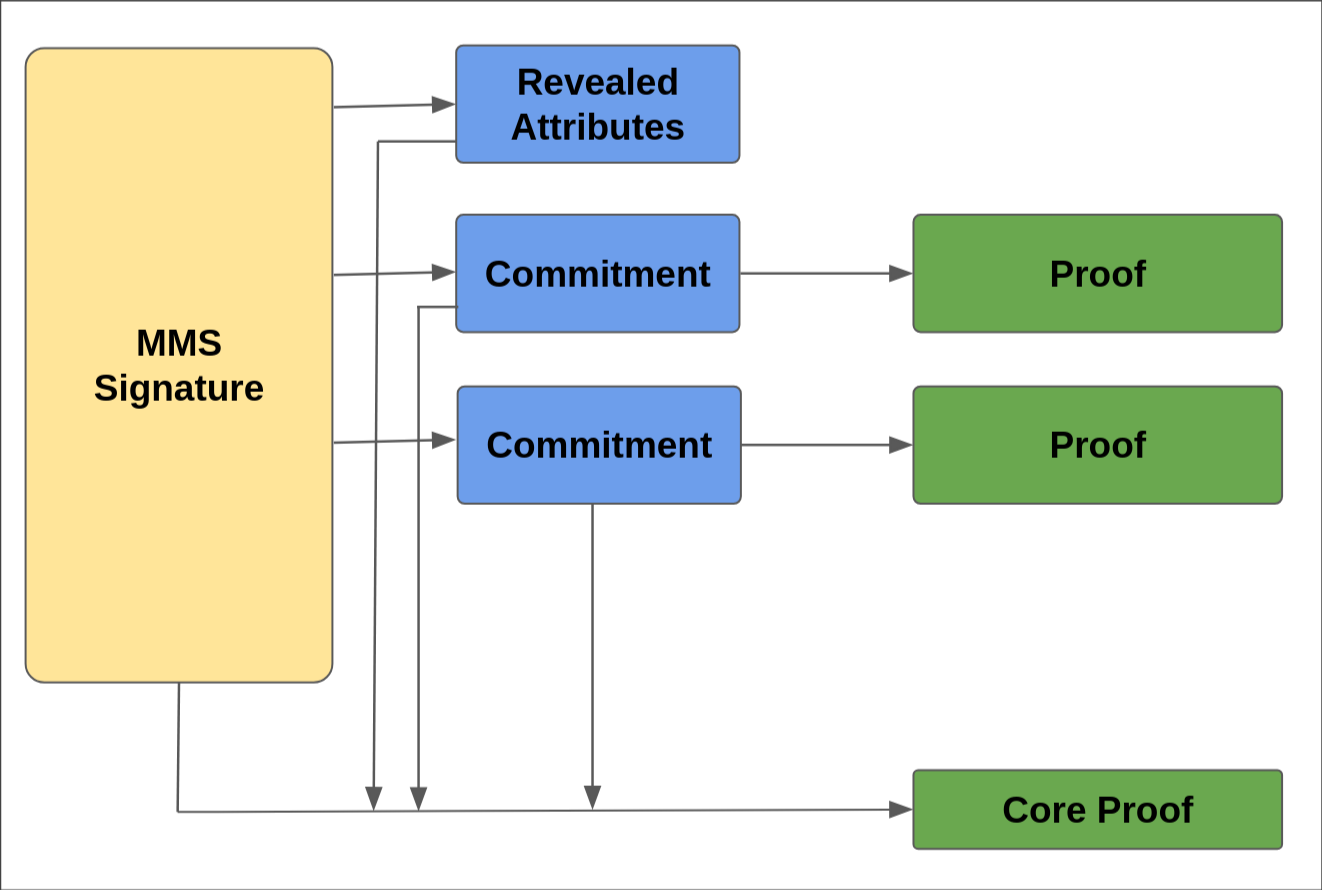
While any combination of MMS scheme, commitment scheme, and ZKP could in theory work to perform the committed disclosure, the building blocks should be "compatible" in the sense that the corresponding "core" proof can be efficiently generated.
Finally, we emphasize that there are already public implementations that follow this approach, in particular DockNetworks, which also has support for some of the more complex predicates such as device binding.
3.1.5 Considerations on Committed Disclosure and Recommendation
The modular approach that relies on the committed disclosure to prove predicates about attributes allows to separate proving knowledge of a MMS and proving predicates on some of the signed attributes. In this section we list some of the main pros and cons about the use of this approach:
Disadvantages
- The resulting proof might result to be less compact and computationally more expensive than a tailored predicate proof that extends the ZKP to prove knowledge of the MMS. For instance, the generation and the inclusion in the proof of the fresh commitments already brings a computational and size overhead. That said, for the instantiations proposed in this work this is hardly an issue since the corresponding overheads are just a few bytes and few milliseconds which will barely be noticeable for a User.
Advantages
- Standardization efforts can focus on how to prove predicates on attributes committed using a commitment scheme while being oblivious of the underlying MMS scheme. These standards can be applied to any MMS that employs committed disclosure using the same commitment scheme.
- Arguing about security becomes easier since each component/module can be analyzed individually.
- Different countries might accept for adoption different lists of predicates on attributes. The framework based on the use of committed disclosure only requires the member states to reach full consensus on the acceptance of equality proofs, as these are needed to prove that freshly generated commitments commit to specific attributes in the attestation. Then, wallets of different member states can implement the specific set of predicate proofs they are willing to adopt.
- Making changes in the future becomes less challenging: each module can be modified or replaced with minimal impact on other components of the system. Further, extensions to the system can be implemented in an ad-hoc way. Hence, in case the requirements for the ZKP functionality should be updated it is likely that this can be incorporated into this architecture with less effort compared to a monolithic approach.
We deem that the advantages of this modular approach outweighs the disadvantage and make the following recommendation.
Recommendation 1: A modular architecture for ZKPs based on MMSs should be used in the EUDI ecosystem.
Remark: In principle, every signature scheme (for example ECDSA) can be considered an MMS by parsing the signed message as multiple messages and using generic techniques for zero knowledge. In this document, however, we are exploring the approach of enabling unlinkable presentations based on signature schemes that support zero knowledge proofs which solely exploit the scheme's algebraic properties and structure. Such schemes usually result in simpler and more efficient constructions since they do not need to prove complex byte-level computations (e.g. correct hashing and parsing).
4 MMS Schemes
A number of MMSs have been proposed in the cryptographic literature. Broadly, they can be divided into two categories: those based on RSA-like cryptography, or those based on elliptic curves. Generally, MMSs that use elliptic curves are deemed the most suitable, as they are more modern and more performant. Many of these MMSs require a special kind of elliptic curves called pairing-friendly curves. These kinds of curves enable efficient algorithms for the RP to verify a disclosure, but support for pairing-friendly curves in current secure hardware is sparse. In this subsection, we discuss a number of elliptic curve-based MMSs as well as some considerations about them in general.
4.1 General Considerations for Elliptic Curve-based MMS Schemes
There are several key considerations for using an elliptic curve-based MMS in the EUDIW context, including those related to Issuers, Users, and Verifiers. Each is outlined in the subsections below.
One thing that applies to all three parties concerns revocation. For mdocs and SD-JWTs, EUDI wallets generally use the Token Status List (draft) standard [IETF-draft-TSL]. This standard endows attestations with a unique identifier that must always be revealed to the RP, which breaks unlinkability. It is not immediately clear how to handle revocation of attestations without breaking unlinkability, but whichever revocation mechanism is chosen will require support from Issuers, wallets and RPs. For more information on various revocation mechanisms that might be suitable, see Section 9.
4.1.1 Issuer Considerations
The primary consideration for Issuers is that deploying an MMS requires changes to both existing processes and infrastructure. These changes arise from how signatures are generated.
It is unclear how PID/(Q)EAA Providers can generate MMSs for eID means at LoA High (and LoA Substantial cf. Section 2.3), since currently available HSMs supports neither MMS schemes, nor pairing-friendly elliptic curves. Suitable pairing-friendly curves are still under standardization in [IETF-draft-pairing-friendly-curves]. Broad hardware support for their use as well as hardware support for MMS signature schemes in signing EUDIW attestations is unlikely in the near term due to the absence of finalized standards and the long lead times for deploying hardware at scale. One way of easing this issue with this could be to modify the MMS such that it can operate on ordinary elliptic curves instead of pairing-friendly elliptic curves. This is discussed in more detail in Section 4.3.
Alternatively, it may be possible to minimize the changes required in Issuer (hardware) infrastructure by having the Issuer create an HSM-backed ECDSA signature on top of the MMS signature to achieve LoA High. Users would present attestations combining the zero knowledge proofs of the MMS with circuit-based zero knowledge proofs of the ECDSA signature to prevent linkability that would otherwise be introduced by the ECDSA signature. This would achieve unlinkability simultaneously with LoA High, while minimizing changes to Issuer infrastructure. It also offers a migration path to the underlying native MMS once hardware support becomes available. How this should be done depends on the specific MMS and requires further study. For BBS, an approach is outlined in [R26].
4.1.2 Wallet Considerations
The wallet must support the MMS signatures too. Specifically, signature randomization and selective disclosure using ZKPs to enable privacy-preserving presentations. This is expected to be feasible, assuming sufficient library support.
A more complex requirement is device binding (as demanded by ZKP_01(iv)). For pairing-based approaches this requirement can be achieved by adding a ZKP of knowledge of an ECDSA signature (see Section 5.1), whereas for pairing-free approaches this can be achieved more directly. While several academic proposals exist, they have not been thoroughly field-tested.
4.1.3 Verifier Considerations
Verifier requirements include support for the MMS signature scheme, including the ability to validate signatures. In the case of pairing-friendly curves, this requires the Verifier to perform pairing operations. Verifiers must also be able to process and validate disclosed attributes in the presentation.
Importantly, all of this can be implemented in software, assuming the availability of finalized standards and mature library support.
4.2 Pairing-Based MMS Schemes
Many MMS schemes require so-called pairing-friendly elliptic curves, which are different from and incompatible with the elliptic curves required by ECDSA.
A pairing-friendly curve is a curve $\mathbb{G}_1$ which is such that there exists other, related elliptic curves $\mathbb{G}_2$ and $\mathbb{G}_T$, along with an efficiently computable function $e : \mathbb{G}_1 \times \mathbb{G}_2 \to \mathbb{G}_T$ which is bilinear.
Bilinearity means that for all $g, h$ and $a$, $b$ the function $e$ satisfies $e(g^a, h^b) = e(g,h)^{ab}$.
Additionally it has to be non-degenerate, meaning that $e(g, h) = 1$ if and only if $g = 1$ or $h = 1$ (or both).
In MMSs, this function (in particular, its bilinearity property) is used by the RP to verify that the disclosed attestation has been validly signed by the Issuer.
4.2.1 BBS
The BBS signature scheme (sometimes also called BBS+) was introduced in [BBS04] as part of a group signature protocol based on discrete logarithm assumptions in groups admitting bilinear pairings. In subsequent work, [CL04] describes BBS as a standalone multimessage signature scheme, supporting efficient issuance and proof protocols over committed messages.
Later, [ASM06] provided a version with provable security, perfect zero knowledge, and improved efficiency. [CDL16] extends BBS to type-3 bilinear pairings and proposes a more efficient proof of knowledge. Most recently, [TZ23] presents a shorter and more efficient variant, which underpins ongoing IETF standardization efforts [IETF-draft-bbs] and the text herein.
Compared to other MMSs that offer similar features, BBS signatures are short (consisting of one elliptic curve element and one scalar), as well as efficient to issue, verify, and prove knowledge of. In addition, it allows the wallet to prove predicates such as range proofs over the attributes that it does not disclose.
In implementations, BBS is typically instantiated with the BLS12-381 pairing-friendly elliptic curve, for which a draft standard has been written [IETF-draft-pairing-friendly-curves]. For the zero knowledge proofs the so-called Schnorr zero-knowledge proofs in the Fiat-Shamir heuristic are generally used. With this approach, the RP first sends a nonce (or challenge) followed by a reply from the wallet containing its zero knowledge proofs. In terms of protocol messages, this has the same structure as an ECDSA Proof-of-Possession (PoP), meaning that this is compatible with the protocol structure of existing protocols such as OpenID4VCI and OpenID4VP for issuance and disclosure of attestations based on ordinary signature schemes.
4.2.1.1 Security level
BBS signatures are provably unforgeable under the q-SDH hardness assumption. The concrete security that the q-SDH hardness assumption can attain is affected by a known cryptanalytic technique by Cheon [C06], which has existed since 2006. Recent work [CT25] presented an explicit algorithm to apply this technique to BBS and thereby showed that the actual security level of BBS is no higher than the provable security level. This means that the most commonly used curve for BBS, namely BLS12-381, would result in a security level of less than 128 bits.
The simplest way to deal with this is to deploy BBS on an elliptic curve that is sufficiently large to compensate. [AFG24] defines the BLS24-509 curve which offers a security level of 192 bits, which is expected to appear in an upcoming version of [IETF-draft-pairing-friendly-curves]. Due to how Cheon's algorithm works, this is sufficient in the sense that the security level of the BBS deployment is then at least 128 bits.
It should be noted that the q-SDH hardness assumption is a well known hardness assumption that has been used by many schemes in the cryptographic literature. As a result, it has received a significant amount of attention and study by cryptographers. Regardless of that, since 2006 when Cheon's algorithm became known q-SDH has resisted all further cryptanalysis looking for any other potential issues affecting its security level. In that sense, q-SDH remains a solid and battle tested hardness assumption.
Given the above analysis, the following approach could be applied.
- Since a lot of BBS implementations using the BLS12-381 curve already exist, and that BLS24-509 is not yet in a (draft) standard, in the short term BBS on the BLS12-381 curve could be used. If BBS is combined with an HSM‑backed ECDSA signature as described in [R26], the unforgeability of the resulting attestation is reduced to the unforgeability of ECDSA: any forgery of the combined construction implies an ECDSA forgery. Hence, this would meet the hardware requirements necessary to reach LoA High (as explained in Section 2.3).
- Migrate to the BLS24-509 curve as soon as possible.
4.2.2 PS
The PS signature scheme was introduced in [PS16], but should be understood as a specific instantiation of a broader framework that is implicit in the Camenisch's and Lysyanskaya's signature construction [CL04]. The CL signature scheme is a re-randomizable signature scheme, meaning that one can publicly derive, from a valid signature on a set of messages, a new signature on the same set of messages. This property is particularly useful in the context of privacy-preserving authentication as one can merely re-randomise a certificate instead of hiding it in a ZK proof. The main downside of CL signature is its size, which grows with the number of attributes to sign. This problem was solved by the PS construction [PS16] that retains the key features of CL signatures (re-randomizability, sequential aggregation, etc) while achieving a constant size for the signature, namely two elements in $\mathbb{G_1}$, regardless of the amount of attributes in the attestation.
Structurally, CL and PS signatures differ from BBS signatures to such a degree that the [CT25] attack does not apply. In other words, there are no known concrete attacks against CL and PS signatures that would perform better than standard discrete logarithm computation, which means that BLS12-381 remains, as of today, a valid option for implementing these mechanisms at a 128-bit security level. More generally, security of PS signatures was initially proven in the generic group model, and later demonstrated using automated tools [ABS16]. Another paper [PS18] showed that variants of CL and PS signatures can also be proven under q-type assumptions, but the latter result does not seem optimal in light of Cheon's attack.
Overall, one must note that PS and BBS should not be opposed. They have different features, suiting different needs, and they rely on different security arguments, providing the cryptographic diversity that is promoted by most standardization bodies.
4.3 Pairing-Free MMSs
Bilinear pairings are widely used in MMS design to let the User prove to the Relying Parties that it is presenting an attestation issued by the Issuer. With bilinear pairings any Relying Party can verify it only using the Issuer public key. An exception are the strong RSA-based CL signatures [CL01]. While pairing-free, they are less efficient than elliptic curve based schemes, due to their reliance on RSA groups. Additionally, they are not naturally compatible with generic sigma protocol techniques which complicates the required ZKPs.
However, as explained in the previous section, requiring a pairing-friendly elliptic curve may delay deployment of MMS schemes that can reach LoA High because currently available certified hardware does not support pairing-friendly curves. For that reason, various ways have been suggested recently to adapt MMS schemes such that they can operate on ordinary, widely supported elliptic curves.
In the elliptic curve based setting, pairing-free variants all require some trade-off in terms of deployment. For instance, one-time use anonymous attestations such as U-Prove [PZ13] or Anonymous Credentials Light [BL13] are based on blind signatures extended to include attributes. Blind signatures are inherently single-show credentials, and thus require batch issuance of credentials for multi-show unlinkability.
Another way to remove the need of bilinear groups is by instructing Relying Parties to interact with the Issuers of attestations during each disclosure in order to help them verify the presentations they receive. This of course brings complexity to the system design since it requires Issuers to be available to support Relying Parties in each verification.
An alternative to this approach instructs the Users to receive batches of helper information from a Helper Server, after which the User can use the Helper information at some later time to generate unlinkable presentations that Relying Parties can verify on their own. The Helper Server issues helper information in batches because each instance must be used only once to preserve the unlinkability of presentations. This approach, referred to as Server-aided Anonymous Credentials (SAAC), was first introduced along with an instantiation called BBS# [DDKT25] (implemented for instance in DockNetwork), and later formalized in [CFLT2025].
Disadvantages
- If the User generates presentations using helper information, then the protocol flow inherits the scalability issues for Issuers existing for the batch issuance of single-use ECDSA attestations.
- If Relying Parties verify presentations with the support of the Issuer, the Issuer must guarantee high availability.
- Pairing-Free MMS schemes rely on additional communication between the Wallet and Issuer before a presentation can be made. Because this communication is necessary before the presentation flow, care must be taken to ensure that it does not enable User tracking, which would be incompatible with ZK_07. The solutions presented in [DDKT25] and [CHLT25] ensure that the data communicated itself does not require the Issuer to identify the User, but the concern extends beyond the content of the communication to include associated metadata. The severity of this drawback should be assessed in light of the fact that similar IP-based tracking vectors already exist in current issuance and presentation flows.
Advantages
- Being defined over standard elliptic curves, support in HSM for protecting the issuance private key can probably be achieved faster and easier.
- Binding a credential to a Holder's secure hardware (i.e., ZKP_1(iv)) is simpler because the secure hardware and the MMS can be defined over the same elliptic curve; for instance, BBS# proposes a solution for device-binding from ECDSA-signatures, relying on re-randomization of ECDSA signatures and public keys.
- Compared to the case where Relying Parties verify presentations with the support of the Issuer, both Users and Relying Parties can be offline while generating and verifying presentations of attestations.
- Compared to batch issuance of single-use ECDSA attestations:
- The protocol to obtain helper information is more efficient compared to a protocol that enables the (possibly blind) issuance of attestations: the helper information is not related to the attributes of the User, but is related only to the Issuer key pair.
- The User is protected against traceability (Issuer and Helper Server colluding with Relying Parties).
- The Helper Server does not learn which User is asking for a batch of helper information: this implies that the Helper Server does not even learn how long it took the same User to use the previous batch of helper information.
4.4 Comparison and Recommendations
MMS schemes smoothly interact with ZK proofs and have been scrutinized for a long time. Their pairing-based versions, regardless of the concrete instantiation, offer performance that can hardly be matched by their competitors. They perfectly address the security and privacy requirements of the EUDI wallet and were actually designed to this end. They however face some deployment challenges due to the lack of support by current secure hardware (HSM, secure element, etc). When considering MMS deployments, we will thus make recommendations for two main phases.
-
Phase 1 (short/medium term): In this phase, it is assumed that the hardware support for pairing-based MMS does not exist.
-
Phase 2 (medium/long term): In this phase, it is assumed that pairing-based MMS schemes are now supported by hardware, which allows to use them even for LoA High.
For Phase 1, for PID at LoA High, one would either:
- Use one of the pairing-free MMS schemes presented in Section 4.3.
- Or combine a pairing-based MMS with ECDSA using circuit-based ZKPs.
Alternatively, for Phase 1, if a PID at LoA Low is introduced, pairing-based MMS can be used without additional ZKPs, incentivize hardware support and thus pave the way to Phase 2.
When comparing MMS with alternative approaches, it is thus important to note that Phase 1 solutions at LoA High are only transitory solutions. The full potential of MMS will only be achieved in Phase 2, at which stage they will arguably supersede other approaches. The distinction between these two different phases also highlights that direct comparison between some of the solutions listed in previous sections is irrelevant. There is for example no point in comparing efficiency or features of PS and BBS# as they fit very different scenarios and requirements.
Hence, below we first compare pairing-based approaches and make a recommendation for Phase 2. Next we compare pairing-based approaches and pairing-free approaches and make a recommendation for Phase 1.
4.4.1 Pairing-based MMSs
Looking at BBS and PS, the two MMSs compare as follows.
Security
- BBS: The unforgeability of BBS is based on the q-SDH hardness assumption. This hardness assumption has existed since 2003 and has been used in many cryptographic works since then. The security level of the q-SDH hardness is affected by a known cryptanalytic technique called the Cheon attack [C06]; see above.
- PS: The paper [PS16] that introduced PS signatures also introduced the hardness assumption on which it is proven unforgeable. It is therefore newer and does not seem as widely used as q-SDH. It is moreover an interactive hardness assumption, whereas noninteractive hardness assumptions such as q-SDH are generally deemed preferable.
Ecosystem and Adoption
BBS is more well known and there are more (open source) implementations of it than of PS.
Efficiency
- BBS: Due to the considerations in Section 4.2.1.1, BBS will eventually require an elliptic curve offering 192 bits of security.
- PS: Can be deployed on an elliptic curve such as BLS12-381 offering 128 bits of security, which should be more efficient. However, the size of a PS Issuer public key depends linearly on the number of attributes that can be issued with it. By contrast, the size of a BBS public key is constant.
It should be noted, however, that in practice both MMSs are efficient to such a degree that it is unlikely that any performance difference would exceed 100ms. In practice, therefore, any efficiency differences between the two matter very little.
All in all, the most promising MMS candidate for now seems to be BBS which seems overall to have a slight edge over PS. Note that because of the modular approach (suggested in Section 3), most of the components can be reused across such schemes if multiple were to be supported.
Recommendation 2: For Phase 2, BBS should be used as the MMS scheme.
4.4.2 Pairing-based vs Pairing-free
Several approaches enabling the use of ordinary elliptic curves, instead of pairing-based ones, have been discussed in Section 4.3.
By itself, this is not sufficient to enable the Issuer to secure its private key in an HSM, since in order to be useful in an MMS deployment the HSM will additionally need to support the MMS signature scheme itself.
Not having to additionally support newer elliptic curves might speed up the process of obtaining suitable certified HSMs, not only because it would involve fewer changes when compared to currently available HSMs, but also because (at least in the case of BBS) the HSM will need to support elliptic curve operations in both $\mathbb{G}_1$ and $\mathbb{G}_2$.
On the other hand, as previously discussed, both elliptic-curve–based and pairing-free approaches (namely SAAC and one-time anonymous attestations) introduce notable drawbacks, mostly in terms of deployment, as issuers are required to manage and distribute attestation material whose size grows linearly with the number of presentations instead of linearly in the number of Users. In addition, the ECDSA/MMS hybrid approach as discussed in Section 4.1.1 might be an alternative that can achieve LoA High for MMS schemes based on pairing-friendly curves.
Recommendation 3: For Phase 1, combining the ECDSA/MMS Issuer hybrid approach as in [R26] with ZKPs of ECDSA signatures to obtain device binding should be further developed for BBS. Certified hardware supporting pairing-friendly curves should be used instead of additional ZKPs as soon it becomes available.
5 Additional Modules
This section presents techniques that can be used to build predicate proofs about the attributes of an attestation following the recommendations stated in earlier sections of the document. The User, during presentation, generates fresh commitments $C_i$ to the attributes about which it wants to prove predicates. Then, the User can generate predicate proofs involving the attributes $a_i$ committed in $C_i$ proving a statement like "the attribute committed in $C_i$ satisfies the predicate".
For the MMSs we consider in this document, the commitment schemes that can be used to efficiently perform committed disclosure are Pedersen commitments.
Recommendation 4: The commitments used in the modular approach should be the Pedersen Commitments and the core proof should be as described in Appendix B of [LSZ25].
In the following we briefly describe how to implement the following predicates for these commitments:
- Device Binding (i.e., enabling ZKP_01(iv)).
- Range Proofs (i.e., enabling ZKP_01(ii)).
- Equality Proofs (i.e., enabling ZKP_03).
- Set-membership Proofs (non-mandatory, but may be used for additional functionality).
5.1 Device Binding
Device binding aims at non-transferability of attestations. It binds the User's attestations to a device key that is stored in a particularly secured hardware component -- dubbed the Wallet Secure Cryptographic Device (WSCD) in the EUDI ecosystem -- and requires a fresh proof-of-possession (PoP) of the device key for every attestation presentation. Native device binding protocols for MMS schemes have been developed and are highly efficient. However, current available WSCDs do not provide the APIs necessary for the native approaches. For short-term deployment (Phase 1 from Section 4.4), device binding solutions that are compatible with the currently existing APIs are therefore necessary. We start by presenting possible short-term solutions that rely only on standard ECDSA signatures for the PoP (which we call "explicit device binding") and hence suitable for Phase 1. Next, we point to the native solutions requiring hardware support for Phase 2.
5.1.1 Explicit Device Binding
The idea of explicit device binding is to rely on the classic approach of including a device public key $dpk$ as an attribute in the User's attestation. Then, every presentation must be accompanied with a fresh PoP of the corresponding $dsk$ which is simply a valid signature $\sigma$ under $dsk$ on a challenge $nonce$ sent by the Relying Party. To do this in a privacy preserving way, neither the public key nor the signature should be revealed. Instead, the User commits to both and proves their correctness via ZKPs. That the public key is the one attested in the User's attestation is proven via the MMS and core proof. Both proofs are combined through the committed public key. The corresponding device binding predicate captures the following:
- $
dpk$ is committed in $C_{dpk}$ - $
\sigma$ is committed in $C_{\sigma}$ - $
\sigma$ is a valid signature of the message $nonce$ under $dpk$.
For efficiency reasons, some constructions may reveal parts of the signature, but only when they contain no information about the User and its $dpk$. Note that the message $nonce$ is known to the Relying Party, and thus revealed in clear.
A common candidate for the signature scheme is ECDSA over the P-256 elliptic curve, as this is supported by common WSCDs. Thus, when using such ECDSA-based device binding with a pairing-based MMS, such as BBS, one needs to additionally bridge the ECDSA public key and signature on the P-256 curve with the pairing-friendly curve of BBS (e.g., BLS12-381). This bridging across groups, and proving knowledge of an ECDSA signature, are relatively difficult to construct. Two main approaches exist: either an optimized circuit-based ZKP (for example some adaptation of [Fs24]) or techniques similar to [CDLS23] and [FLM21], which rely entirely on classical Schnorr proofs. The Schnorr-based approach has been described in detail for ECDSA device binding for BBS in Section 4 of [LSZ25] and implemented by Ubique and DockNetworks, whilst Sigpop implements the circuit-based approach. In the pairing free variant ECDSA device binding is compatible with existing WSCDs through a standard ECDSA interface.
Comparison of circuit-based and Schnorr-based approaches. As for efficiency, circuit-based approaches tend to be faster for proving/verifying. Schnorr-based constructions tend to be simpler than circuit-based ones, which could make implementation and standardization easier, and are also compatible with the MMS schemes we consider in this document. They require, however, an additional elliptic curve, specifically the T256 curve proposed in [FLM21] (this is also the case for some circuit-based solutions which use this curve for optimizations). The T256 curve has not been standardized yet.
Comparison with attestation system based on ECDSA and circuit based ZKPs. A solution relying on an MMS and a separate module for ECDSA device binding is much simpler than attestations directly built with ECDSA (i.e., ECDSA is used also for attribute signing). Indeed, when using ECDSA only for device binding, a simpler statement needs to be proven since (1) the nonce is a public message that does not identify the User and (2) revealing part of the ECDSA signature is possible without compromising privacy (as the PoP signature is only used once, and only known to the User). In particular, no statement over a hash function must be proven, which is often the most complex part when using a circuit-based ZKP. Therefore, solutions using a dedicated MMS for proofs over attributes and ECDSA only for the device binding part are inherently simpler and lighter than a construction using ECDSA for both. Separating the signature scheme used for signing the attributes and for device binding allows flexibility and enables making optimal choices for both (an efficient scheme for handling attributes and a legacy one that is widely deployed).
5.1.2 Native Device Binding
Native device binding essentially follows the same concept as explicit device binding, but has a PoP already integrated into the MMS's ZKP.
The most established way for such native device binding of anonymous attestations/MMS is the Direct Anonymous Attestation (DAA) protocol [DAA04]. DAA essentially requires a simple Schnorr signature (in $\mathbb{G}_1$ of the pairing-friendly curve) from the WSCD and only a single exponentiation per presentation.
That is, the WSCD does not have to compute the full ZKP over the MMS, but only the proof of possession of the device secret key to which the attestation is bound, which takes a few milliseconds.
The DAA protocol was standardized by ISO (for BBS and CL signatures) in 2013 [ISODAA], and is supported by the TPM2.0 standard. The interfaces were designed to support a broad range of MMS, and the ISO standard has recently been updated to also include PS signatures [ISODAA].
DAA requires two calls to the WSCD per presentation and requires the WSCD to keep state among both calls. This has recently been improved in [FHLL25] which only needs access to a standard BLS-signature interface on the WSCD, i.e., requires only a single API call and no state. It is also the first protocol for BBS signatures that does not require trusting the WSCD for unlinkability and comes with a privacy-preserving variant for remote HSM settings as currently considered in several member states.
Such native device binding will be significantly more efficient than any ECDSA-based solution, and suitable for offline scenarios where bandwidth is very limited. However, it requires WSCDs to add new interfaces, e.g., for Schnorr or BLS signatures over a pairing-friendly curve. BLS signatures are an interesting stand-alone signature that provides easy mechanisms for key splitting and blind signing. Using BLS signatures for device binding immediately provides several advanced capabilities for the User/device key management.
5.1.3 Proposition for Explicit Device Binding Implementation
Given that the more efficient Native Device Binding cannot be deployed in the near future due to lack of hardware support, an Explicit Device Binding Construction should be initially implemented and only in the Phase 2 (mid/long term) support the former. Due to the (relative) simplicity and adequate efficiency, the aforementioned Schnorr-based approach looks like the most promising path; the only caveat is that explicit device binding makes use of the non-standard T256 curve or some similar variant. A starting point for the implementation is the library of DockNetworks.
Recommendation 5: For Phase 1, device-binding should be achieved using a Schnorr-based approach.
The concurrent work that is done in TS13 can in principle be adapted and simplified to yield a circuit-based approach for ECDSA device binding. However, we consider this a less promising candidate for explicit device binding due to the complexity of standardizing the needed arithmetic circuit and proving system.
5.2 Range Proofs
A range proof allows showing that an attribute lies in some range without revealing anything more about it. They can be used for implementing various features (revocation, non-expiration, pseudonyms amongst others). To prove that an attribute $m$ lies in some range $[l, h)$, the User produces a commitment $C$ to it during presentation and then uses a ZKP to prove that $l\leq m < h$. Concretely, the User computes a fresh commitment $C$ to the attribute $m_i$ that needs to be range-checked and a ZKP is used to prove a predicate that captures that
- $
m_i$ is committed in $C$, and - $
l\leq m_i < h$.
There are various options of instantiating the ZKP with different trade offs. The two main categories build upon:
- binary (or n-ary) decomposition (e.g. [BBBP+18], [BFGW20]) where the prover proves a statement of the form $
x \in [0, n^l)$ by committing to an n-ary decomposition $(x_0, . . . , x_{l−1})$ of $x$, and proving that $x = \sum_i x_i n^i$ and each $x_i\in [0, n)$. - square decomposition (e.g. [CKLR21],[CGKR22]) instead allows to prove a statement of the form $
x\ge 0$ by using integer commitment schemes to commit to $x$ over $\mathbb{Z}$ and proving the existence of four squares such that, being $x_1,x_2,x_3,x_4\in \mathbb{Z}$, $x=\sum_{i=1}^4x_i^2$. This approach generalized to random intervals $[a,b]$ by proving the non-negativity of $(x-a)(b-x)$.
The state of the art approach for n-ary decomposition is Bulletproof [BBBP+18] that builds on top of Pedersen commitments and would be compatible with the data encoded in the multi-message signatures considered in this document.
Regarding square decomposition, until recently, the only integer commitment schemes were defined over hidden-order groups (like RSA groups), making their performance and proof size not comparable to those achieved by using Bulletproofs. Integer commitments defined over known-order groups was firstly introduced in [CKLR21], and later improved in [CGKR22] where the authors present $\mathsf{Sharp_{SO}^{Po}}$ (working on elliptic curve groups of prime order $p$ of 256 bits), a construction also adopted in [KRS25].
Both $\mathsf{Sharp_{SO}^{Po}}$ and Bulletproofs benefit from a transparent setup and, if run on a laptop, they have prover and Verifier time within a dozen of milliseconds for a single proof, ranges less than 32 bits and soundness of 128 bits. The size of the proof is in both cases within a KByte (see [CGKR22], Section 1.1.1 for more details about the comparison). The performances of $\mathsf{Sharp_{SO}^{Po}}$ are slightly better than those of Bulletproofs for a single proof, but if we consider proof batching (even for small batches like 8 proofs) Bulletproofs outperforms $\mathsf{Sharp_{SO}^{Po}}$. Also it is worth mentioning that Bulletproofs is a more established technique, therefore it is surely appropriate as a short-term solution for the generation of range proofs. However, given its performance $\mathsf{Sharp_{SO}^{Po}}$ may also qualify for mid-term adoption.
Recommendation 6: For Phase 1, range proofs should be achieved using Bulletproofs.
A survey of zero knowledge range proofs can be found in [CBCM+24], however, we remark that for small ranges with few possible values, an approach based on set membership proofs, as described below, is viable.
5.3 Equality
Equality proofs allow a User to prove that a committed attribute equals a message committed in an external commitment $C_{ext}$. This module can be useful to link presentations of different attestations by proving that they share a same random attribute, realizing Combined Presentation of Attestations as specified in the ARF in a natural and simple way. Concretely, to realize ZKP_03, a PID Provider could include a message containing a large random number. To bind an attestation to this, the other Issuer would also include this random number in the message. Upon presentation, the User would make a committed disclosure to both numbers together with an equality proof of these commitments.
Assuming an external commitment $C_{ext}$ (which in practice is derived from a presentation of a different attestation), the User computes a fresh commitment $C$ to the attribute $s$ and uses a ZKP to prove a predicate capturing that
- $
s$ is committed in $C$, and - $
s$ is committed in $C_{ext}$.
For the concrete case of linking attestations, the User can simply add the "linked" attributes in the set of committed attributes for both presentations (thus establishing consistency with both attestations) and use a single proof for the equality predicate. Equality proofs of attributes committed in Pedersen commitments can be generated using a well known and simple modification to Schnorr zero knowledge proofs.
Recommendation 7: For equality proofs, Schnorr proofs should be used.
Various implementations are available, for example DockNetworks and Sigma Proofs.
5.4. Set Membership
Set membership proofs allow a User to prove that a committed attribute has a value within a set $S=\{s_1, s_2, \ldots, s_n\}$ of values without disclosing the value of its attribute. This module can be useful to prove for example that the citizenship of the User is within a set $S$ of countries.
This type of proof is also useful in designing range proofs by showing that their age lies within a given range (for instance between 18 and 30), where the set would be the set of integers in that range.
The User computes a commitment to the attribute $m_i$ that needs to be restricted to belong to $S$ and uses a ZKP to prove that
- $
m_i$ is committed in $C$, and - $
m_i = s_1$ or $m_i = s_2$ $\dots$ or $m_i = s_n$.
Set membership proofs of attributes committed in Pedersen commitments can be generated using the standard compiler for OR proofs that turns a sigma protocol for equality proofs into a OR proof [CDS94].
Recommendation 8: For membership proofs, OR proofs together with equality proofs should be used.
A relevant implementation can be found in Sigma Proofs.
6 Issuance
6.1 Data that must be Issued
To enable ZKPs based on MMSs, the data being issued must contain
- A header signed by the Issuer containing information that is always disclosed. This header contains:
- An algorithm (signature scheme + curve) identifier (either explicit or implicit since that format is only used with one algorithm).
- Other possible metadata entries that are always disclosed (e.g., policies embedded in the credential that must presented).
- The list of messages / attributes that the signature is constructed over with their respective indices (either explicit or implicit via an ordered list).
- The device public key that the credential is bound to -- can be conveyed in one or more (potentially blinded) messages (e.g., BBS#, DBAC) or a special construction that is part of the signature scheme itself (e.g., DAA type proof).
6.2 OID4VCI for MMS
Below we list the relevant extension points in OpenID4VCI for transferring the data listed above.
The so called proof object used for a Proof of possession. OpenID4VCI currently supports the following proof types:
jwt: A JSON Web Token that is signed with the device private key and contains a server-provided challenge.di_vp: A W3C Verifiable Presentation object signed using the Data Integrity Proof.attestation: A key attestation that also contains a server-provided challenge and the device public key. Signed by a trusted source (e.g., secure element, or Wallet Provider).
Which of these can be used depends heavily on the device binding construction, but the current assumption is that most constructions will provide a device binding bridging to ECDSA on P-256 since those are commonly supported in current smartphone hardware.
For ECDSA, the jwt or attestation proof types can be used during issuance for the proof of possession---requiring no changes compared to the issuance of credentials of types SD-JWT VC or mDoc.
The most important extension point in OpenID4VCI are Credential Format profiles, with some being defined in Appendix A of OpenID4VCI:
- W3C VCDM based credentials of different variants.
- ISO 18013-5 / mDoc.
- IETF SD-JWT VC.
A credential Format profile defines:
- A credential Identifier: A string representing the credential format in the scope of OpenID4VCI / issuance.
- Credential Issuer metadata: Credential format specific metadata used to identify supported algorithms (for both, credential signature scheme and device binding) and specify any format specific properties (e.g., information representing the type of credentials being offered, dependent on the chosen data model - for example doctype for mdoc, or vct for sd-jwt vc).
- Authorization details: How
authorization_detailsis specified if instead of scopes, a Rich Authorization Request (RAR) is used by the Issuer. - Credential response: The definition how an issued credential is transmitted in the JSON object returned by the credential endpoint (e.g., base64 encoding if the native serialization of the format is binary).
An MMS would need to define those components, but construction is straightforward if a choice on the used container format is made (see discussion below).
7 Presentation
7.1 ZKPs in a presentation
The presented data contains
- For the core credential proof:
- An algorithm identifier (proof scheme + curve)
- A list of disclosed attributes including their indices
- Additional inputs that were used in the proof generation (e.g., additional transaction data that the presentation is bound to)
- The encoded proof to be verified
- A list of sub-proofs if applicable, where each sub-proof contains
- An input commitment (that is part of the list of the commitments provided in the core proof)
- A proof type identifier (e.g., an identifier signaling that this is a range proof using a bulletproofs construction)
- The encoded proof to be verified
7.2 OID4VP for ZKPs based on MMS
The relevant extension point for ZKPs based on MMSs in OpenID4VP are Credential Format Specific Parameters and Rules. OpenID4VP defines such parameters and rules for credentials based on W3C VCDM 2.0, ISO 18013-5 mDoc, IETF SD-JWT VC in Appendix B. They usually consist of:
- Format identifier: An identifier representing the credential format and its encoding rules
- Transaction data rules: Defining a credential data mechanisms that specifies how credentials of this type deal with
transaction_dataand if applicable how its presence can be verified in the resulting proof. For most MMS schemes, defining a construction that adds a hash over thetransaction_datainput from the request into the challenge hash that is also used for additional input like audience binding and nonce should be sufficient. Additional rules might have to be defined on a per transaction data type level and are out of scope for this discussion. - Metadata: Credential format specific metadata provided by the Relying Party that allows the wallet to decide if a presentation will be understood by the RP. Usually defines a list of supported algorithm identifiers (credential signature scheme and device binding)
- Query Language adjustments: Credential format specific extensions to the query language/logic. Usually consists of the definition of the content of the
metaparameter that is used to transport format-specific information (e.g., information that allows for credential type matching such asdoctype_valuefor mDoc orvct_valuesfor SD-JWT VC). - Presentation Response: Format and Encoding of the transmitted data and if applicable a description on how to map components to a request (especially the query language mapping).
An example for such a definition (without transaction data) can be found in earlier versions of OpenID4VP for the CL-signature based AnonCreds construction: OpenID4VP draft 26
Note that some extensions to the query language defined in OpenID4VP (DCQL) will be necessary to express the full range of possible sub-proofs / predicate proofs. There are concepts on how to express more advanced logic on top of claims, but the decision was made to not include them for OpenID4VP 1.0 and wait for more implementers experience before adding any extensions. One option that was discussed was to extend claim matching in DCQL with "Transformed Claims" as defined in Section 8 of OpenID Connect Advanced Syntax for Claims that allows for the definition and application of pre-defined functions that would then map to sub-proof constructions. Such an extension to DCQL will be necessary for any MMS scheme that supports predicate proofs / sub-proofs of any kind and applies to circuit based constructions as well.
8. Data Model and Container Format
For a concrete discussion on protocol integration, choices in regards to the data model and container format have to be made. The general assumption is that one combination of data model and container format are chosen, with their properties being that there is
- One representation/format for issuance.
- One representation/format for presentation (that supports selective disclosure and potential sub-proofs).
8.1 Data Model
There are different possibilities for data models that could be used in combination with MMS Schemes. This is similar to the different data models existing in the current credential world, for example:
- IETF SD-JWT VC, defining a JSON based data model for credentials based on SD-JWT
- ISO 18013-5 / mDoc, defining a CBOR based data model for credentials on top of COSE
- W3C Verifiable Credential Data Model (VCDM) 2.0, defining a graph-based data model
Other models also exist.
8.2 Container Format / Serialization
Similarly, there are different options to serialize different kinds of digital credentials in current ecosystems. Choices in the data model also have influence on the most appropriate serialization format, and these two are often tightly coupled. There seem to be two options available right now that can be roughly matched with the data models introduced above:
- IETF JSON Web Signatures (JWS) and JSON Web Tokens define several serialization formats for JOSE based credentials / tokens and SD-JWT defines its own format on top
- ISO 18013-5 / mDoc defines a CBOR based serialization format based on COSE
- W3C Data Integrity builds on top of W3C VCDM 2.0 JSON-LD and its graph structures (RDF canonicalization) for its serialization
There are also standardization efforts for credentials based on MMS, such as:
- W3C Data Integrity BBS Cryptosuites based on the W3C VCDM 2.0 and Data Integrity Proofs
- IETF JSON Web Proofs, defining a JSON and CBOR based serialization, providing support for multiple messages and multiple proofs
- IETF BBS core defines own serialization rules in section 4.2.4
8.3 Example format based on JSON Web Proofs (JWP)
To make the discussion on data model and container format more tangible, an example credential format based on [IETF-draft-JWP] is constructed, but any of the data models & serialization combinations could easily be integrated. For simplicity, this example format re-uses larger portions of the data model of SD-JWT VC to keep those aspects as close as possible to currently deployed implementations and avoid changes to business logic as far as possible.
8.3.1 Example format: Data model
We choose to inherit from SD-JWT VC:
- the
vctclaim as described in section 3.2.2.1 of SD-JWT VC, the associated credential type system, and type metadata - Claim metadata as described in section 9 of SD-JWT VC that allows for an easy description of claims and associated display/rendering information
The confirmation claim cnf is not used to associate the device public key -- this information is instead conveyed in dedicated messages depending on concrete device binding variants.
A valid credential of this type in its core JSON form would be very similar to the processed payload of an SD-JWT VC, for example:
{
  "vct": "urn:eudi:pid:de:1",
  "nbf": 1683000000,
  "exp": 1883000000,
  "age_over_65": true,
  "nationality": ["DE"],
  "resident_address": "Musterstrasse 12, 12345 Musterhausen",
  "place_of_birth": {
    "country": "DE",
    "locality": "Berlin"
  }
}
To use this in combination with a MMS scheme, a transformation algorithm has to be defined that maps the keys in this map to the indices of the MMS attributes. It is important to note that this transformation algorithm should preserve the ability to create sub-proofs over attribute values, hence a simple transformation into a construction encompassing JSON path and value information into singular messages is likely not a good idea.
The simplest form of such a transformation is to extract structural information into an Issuer provided header that is always presented. Note that this leaks some information and it depends on the concrete use-case and credential type if always exposing structural information creates privacy problems. In particular, exposing the header narrows a Holder’s anonymity set to only those holders whose credentials share the same header and the same disclosed attribute values. Therefore such headers must be kept identical across a large population of issued credentials of the same type. To do this decoy values can be added to mask array entries or optional fields - decoy values could guarantee a static header that is shared among all issued credentials of a specific type.
Example header for the JSON payload provided above:
{
  "vct": "urn:eudi:pid:de:1",
  "nbf": 1,
  "exp": 2,
  "age_over_65": 3,
  "nationality": [4, 5],
  "resident_address": 6,
  "place_of_birth": {
    "country": 7,
    "locality": 8,
    "region": 9
  }
}
Note that decoy entries for "nationality" and "region" were added to mask the size of the array and a missing optional attribute (see place_of_birth definition in the PID rulebook). In this example, vct is a mandatory attribute and always disclosed. The numbers represent the index that is associated with each message, but an offset could easily be added (e.g., if the device public key always takes up 8 messages, you would add an offset of 8 to these indices).
The credential would then contain the structural information that is embedded in the credential via a protected header that is always disclosed. The messages that are signed over would then contain these values:
m_1 = 1683000000
m_2 = 1883000000
m_3 = true
m_4 = "DE"
m_5 = null
m_6 = "Musterstrasse 12, 12345 Musterhausen"
m_7 = "DE"
m_8 = "Berlin"
m_9 = null
There also exist more complex variants that fully transforms JSON in multi-message encodings encoding both positional/structural information and the values into messages if always disclosing a header would leak too much information. Note that the positional encoding (index of a value) in multi-message signature schemes always leaks a bit of information unless a static structure that all attestations of that type fit in can be defined.
8.3.2 Example format: Serialization
This section roughly describes a JPA Algorithm that would be necessary for such a construction based on JWP. This needs to be created as a proper/full specification and this section should not be understood as such, but rather as a rough estimate on what has to be defined.
Larger parts of the following sections are derived from the BBS section in [IETF-draft-JPA].
JPA Algorithms:
- Proposed cipher suite identifier (
algvalue):BBS_BLS12381G1_SUBPROOFS:SHA-256_SSWU_RO_
Key Format:
- as defined for BBS in 6.3.2 [IETF-draft-JPA]
- The P-256 device key is embedded in the BBS messages according to section 4.1 of [LSZ25] using limb decomposition:
- 8 (2x4) messages that encode the x and y coordinates of the P-256 public key, where each coordinate is represented using:
- limb 0: bits 0-63 (least significant bits)
- limb 1: bits 64-127
- limb 2: bits 128-191
- limb 3: bits 192-255
- 8 (2x4) messages that encode the x and y coordinates of the P-256 public key, where each coordinate is represented using:
Issuance:
General issuance requirements as defined for BBS in section 6.3.3 of [IETF-draft-JPA]. An offset of 8 is added to the messages for the encoded P-256 public key -- i.e., the first 8 messages are reserved for key binding.
A new cipher suite for [IETF-draft-BBS] has to be defined that allows for an explicit signal to not apply hash-to-curve [RFC9380] to inputs. Several sub-proofs will not be possible unless the original scalar inputs are preserved (e.g., device binding proof, range proofs). We propose to add an explicit signal for implementation robustness, that could for example be added to the header information by embedding an additional boolean value that signals whether or not to apply hash-to-curve.
Non-normative example of a protected header including a boolean flag whether or not hash-to-curve is applied:
{
  "alg": "BBS_BLS12381G1_SUBPROOFS:SHA-256_SSWU_RO_",
  "vct": "urn:eudi:pid:de:1",
  "nbf": [9, false],
  "exp": [10, false],
  "nationality": [[11, true], [12, true]],
  "resident_address": [13, true],
  "place_of_birth": {
    "country": [14, true],
    "locality": [15, true],
    "region": [16, true]
  }
}
This would result in messages 1-8 being reserved for the device binding, for messages 9,10 hash-to-curve is not applied to preserve the original scalar input to allow for range proofs (proofs that current_time > nbf and current_time < exp), for the other messages 11-16, hash-to-curve would be applied.
Issuance Proof Verification:
Holder verification of the signature on issuance form is performed using the Verify operation in section 3.5.2 of [IETF-draft-BBS].
This operation utilizes the issuer's public key as PK, the proof as signature, the Header octets as header and the array of payload octets as messages.
Presentation:
Derivation of the core proof is done by the Holder using the NIZKCD.P operation from Appendix B of [LSZ25]. Note that this diverges from proofGen as defined in [IETF-draft-BBS] to allow for commited disclosures.
The NIZKCD.P operation also takes a vector of indexes, describing which payloads the Holder wishes to disclose. All payloads are required for proof generation, but only these indicated payloads will be disclosed for later proof verification. Additionally, it utilizes a vector commited disclosures.
It also uses the adjusted cipher suite described above that allows to switch between hash-to-curve or using the input scalar directly is applied.
Sub-proofs are generated as encoded structures encompassing a sub-proof algorithm identifier, the input commitment, and the proof. A serialization format for the different sub-proofs needs to be defined and the proposal would be to keep things similar to the JWP encoding. Specific sub-proof encodings have to be defined for every sub-proof introduced in section 5.
Non-normative example of JSON encoding of a range proof (to be defined for the different sub-proofs):
{
  "alg": "some_rangeproof",  // sub-proof algorithm identifier
  "input": {                 // inputs to the sub-proof
    "c": 12345,              // committed value
    "i": 10,                 // message index that the commited value belongs to
    "l": 42,                 // lower bound
    "h": 5000,               // upper bound
  },
  "proof": "ey..."           // encoded proof as specified for that algorithm
}
This example would fit to the range proof as defined in Section 5.2:
- $
m_i$ is committed in $C$ (index i, commitment c). - $
l\leq m_i < h$ ($m_i$ is the committed value,landhthe lower and upper bound).
Note that commitment c and commitment index i are expected to be present for all sub-proofs since they are the binding the sub-proof to the BBS core proof.
The proof parameter in the JWP serialization contains an array of proofs with the first element being the core BBS proof and subsequent elements being sub-proofs.
Presentation Verification:
The Verifier decodes the Presented Form of the JWP and resolves the core proof and sub-proofs from the proof array. The Verifier uses the list of disclosed messages, the list of commitments, and the encoded proof as input to its verification logic.
9 Revocation
Revocation of issued attestations or certificates is generally complex, because it is difficult to simultaneously achieve all desirable properties such as efficiency, scalability, and minimal delay between actual revocation and when it takes effect. In an MMS deployment, it is additionally desirable that revocation can be done without harming the unlinkability feature that the MMS offers. Several technologies exist that can satisfy some of these desired features. This section describes several of these technologies, and characterizes them based on the following criteria:
- Unlinkability: the revocation mechanism prevents multiple presentations from the same attestation from being linked based only on (1) the presentations sent to relying parties, (2) public information and (3) information known by issuers and revocation managers.
- Additional privacy threats: the revocation mechanism forces or may induce Users to leak private information (e.g. when they are online, if they are going to generate presentations)
- Availability: the availability required by wallets and Verifiers who might need to update the information needed to prove and verify the non-revocation of the attestations,
- Efficiency and scalability: the efficiency of revocation managers (who must set up the revocation mechanism), Holders (who must generate proofs of non-revocation) and Verifiers (who must verify non-revocation proofs).
- Revocation latency: the time from when a revocation is initiated until a Verifier will no longer accept a presentation of the credential. It depends on how quickly revocation data (updates, lists, tokens) are published, how often Verifiers/wallets fetch or receive them, and any remaining token lifetime (e.g., short-lived tokens). These parameters can be tuned to reduce latency (for example, by pushing updates more frequently or shortening token validity), but doing so typically increases operational cost and, in some designs, can expose more User metadata and reduce privacy. Below when presenting the different revocation mechanism the relevant latency trade-offs will also be presented.
The following subsections describe candidate revocation mechanisms and assess each against the criteria defined above (unlinkability, additional privacy threats, availability, efficiency/scalability, and revocation latency). We conclude with a recommendation for the approach that best balances these criteria for the EUDI ecosystem.
9.1 Accumulators
Accumulators are sophisticated cryptographic primitives that offer both scalability and unlinkability, through the use of zero knowledge proofs. They are, however, cryptographically relatively complex, and they put more demands on the wallet than other revocation solutions do.
Briefly, accumulators are a cryptographic primitive that allows a User to prove in zero knowledge that they know a value that is an element of some set $S$.
In our case, $S$ would correspond to the set of issued and unrevoked attestations.
The accumulator itself is some value $A$ whose size is constant: it does not grow in size as the amount of accumulated values grows.
In terms of scalability, this makes it very suitable to prove nonrevocation in an MMS deployment.
The accumulator and the set $S$ are generally managed and updated by an Accumulator Manager.
Since in EUDI wallets the Issuer of an attestation must be the one that revokes it, we assume here that the Issuer is also the Accumulator Manager.
In EUDI wallets, accumulators that are dynamic, positive, and have optimal communication complexity would be most suitable. Rather than defining these terms in detail, this section describes how such an accumulator could be deployed alongside an MMS in an EUDI wallet.
-
Key generation: The Issuer generates the initial accumulator value and makes it available to wallets and RPs. This accumulator changes value whenever the Issuer revokes an attestation (see below). The latest accumulator value must always be available for wallets and RPs.
-
Issuance: Alongside the attestation signature, the Issuer generates:
- A special-purpose revocation attribute that is included in the attestation,
- A so-called nonrevocation witness.
This witness is valid over the revocation attribute against the issuer's current accumulator, like a signature over a message can be valid against a public key. During issuance, the Issuer stores the revocation attribute for this attestation in a database for later revocation. The wallet stores the witness alongside the attestation.
-
Disclosure: During disclosure, along with the disclosed attributes the wallet sends to the RP a nonrevocation proof, which proves in zero knowledge to the RP that the witness of the attestation is valid against the issuer's current accumulator, without revealing either the witness or the revocation attribute. From this the RP infers that the attestation is not revoked. Due to the zero knowledge property of the nonrevocation proof it learns nothing else besides that fact.
-
Revocation: When the Issuer wants to revoke an attestation, it first looks up in its database the revocation attribute for that attestation that it stored after issuance. Using this, it (1) updates its accumulator to a new value, and (2) makes available to all wallets a witness update message. Wallets containing (non-revoked) attestations use these update messages to update their witness, so that it becomes valid against the new accumulator, allowing them to prove nonrevocation against it. This update algorithm is such that it does not work for the witness of the revoked attestation, so that the containing app can no longer prove nonrevocation.
An important property of accumulators as described above is that whenever an attestation is revoked, wallets need to receive a witness update message created by the Issuer in order to update their witness. If a wallet misses one of these update messages it cannot update its witness to be valid against the latest value of the accumulator. That results in the wallet being unable to prove to the RP that its attestation is unrevoked, which likely leads to the RP rejecting the entire disclosure.
This revocation mechanism therefore necessitates reliable software and protocols to distribute these update messages from the Issuer to all wallets. It also means that the number of update messages that a wallet has to process to update its witness grows with the number of revoked attestations since the last time the wallet performed this process. We note that if either situation becomes a problem, then a lightweight protocol for reissuing an outdated witness could be used, in which the wallet first discloses the revocation attribute to the Issuer of its attestation, and if that corresponds to a nonrevoked attestation, then the Issuer replies with a fresh witness. Such a protocol will need to be developed and standardized, however. In the meantime, the entire attestation could simply be reissued. Since either process would identify the User to the Issuer, a balance will need to be struck between the privacy impact of this protocol versus the performance of the wallet needing to process a lot of update messages.
The following accumulators have the required properties.
- [BCDL+17]: The first accumulator with optimal communication complexity having the required features. It is RSA-based, which means it is not optimally efficient and less suited for MMS deployments using (pairing-friendly) elliptic curves.
- [KB21]: Uses pairing-friendly elliptic curves. The paper defining this accumulator uses so-called Type 1 pairing elliptic curves, which are now deemed less secure as well as less efficient compared to Type 3 pairings that are used by (modern versions of) BBS. However, it should be possible to convert the accumulator from this paper to use Type 3 pairings, and this has in fact already been implemented. This additionally opens the possibility for using a single pairing-friendly elliptic curve for both BBS and the accumulator, which should increase efficiency. Further study to validate that this does not impact security or privacy is required, however.
To summarize, we can state that:
- Unlinkability: the unlinkability of presentations is not compromised
- Additional privacy threats: Users might fetch the witness updates before generating a presentation which may allow the User to be traced because of the communication metadata. However, if the witness updates are public and non-specific for User this may limit the leakage to the manager. This information is always leaked to the manager if the manager reissues the User's witnesses instead of publishing witness updates.
- Availability: both the wallets and the Verifiers must be available to receive the update messages at the end of every epoch, when the manager updates the accumulator value (removing the revocation attribute of the attestations revoked during the epoch) and broadcasts the witness update messages.
- Efficiency and scalability: the manager computational and communication cost is linear in the number of revoked attestations as it must update the accumulator and broadcast the witness update messages. The computational and communication complexity increases linearly with the number of un-revoked attestations if the manager must compute the update witnesses for the unrevoked attestations. Holders generate proofs in constant time, and update their witnesses in time linear in the number of revoked attestations during an epoch (if they update it, and do not receive a fresh one from the manager). Verifiers verify proofs in constant time.
- Revocation latency: revocation becomes effective for a given wallet once the Issuer publishes the accumulator update and the Verifier fetches this updated accumulator. In an ideal push-based design where the Issuer immediately publishes updates and wallets promptly receive them, latency can be near real-time. In practical deployments where updates are batched into epochs or wallets poll periodically, latency equals the epoch length or the poll interval (minutes to hours, potentially longer). Thus, accumulator-based latency ranges from near-instant (with robust push and coverage) to epoch-length.
Finally, some accumulator constructions require the manager to hold a secret “trapdoor” or private key in order to add or remove elements (e.g., classic RSA-style accumulators or many dynamic constructions), while other designs allow certain public updates. Any secret that may be used to circumvent the soundness of the accumulator cryptographic material must be protected accordingly. Concretely, to meet the key protection requirements for LoA Substantial and High discussed in Section 2.3, issuers/accumulator managers must be able store these secrets in certified hardware.
9.2 Short-lived attestations
Another revocation mechanism that can be used relies on the use of short-lived attestations and is inspired by [BCDE+14].
In this case, the wallet is given a main long-lived attestation containing all the User attributes and a special attribute called revocation handle $RH$.
In addition to the main attestation, the User is issued a short-lived revocation attestation that contains as attributes only $RH$ and the expiration date, which might be 24-72 hours after its generation.
Every time the User generates a presentation, it must prove to know both a valid main attestation and an unexpired revocation attestation whose revocation handle $RH$ match. Whenever the revocation manager wants to revoke the main attestation of a User, it stops issuing the revocation attestation for that specific main attestation.
The advantage of this approach, relying on the short-lived revocation attestation, compared to an approach where the main attestation is short-lived, is that the revocation manager does not have to store the attributes of every User whenever it renews the User's main attestation.
This approach also stays compatible with existing Issuer infrastructure as only re-issuance of revocations are required from the Issuer.
Short-lived attestations requires generating a proof that two attributes in two distinct attestations are the same. Even though this kind of operation is not described this document, we observe that this can be easily done by performing the committed disclosure of the attribute $RH$ in both attestations generating the commitments $C_l$ (in the core proof of the long-lived attestation) and $C_s$ (in the core proof of the short-lived revocation attestation), then by generating an equality proof of the message committed in $C_l$ and $C_s$.
To summarize, we can state that:
- Unlinkability: the unlinkability of presentations is not compromised.
- Additional privacy threats: Users will have to query the manager for a new short-lived credential before generating a presentation. This communication metadata leaks to the revocation manager if (and when) the User is online.
- Availability: the wallets must be available to receive the new short-lived attestation, Verifiers do not need to be available (unless the public key of the short-lived attestation rotates).
- Efficiency: the manager computational and communication cost is for each epoch linear in the number of unrevoked attestations as it must reissue short-lived attestation. Holders and Verifier generate and verify proofs in constant time.
- Revocation latency: revocation latency in this design is bounded by the remaining lifetime of the current short-lived attestation. If the revocation manager stops issuing new short-lived attestations, a compromised credential can still be used until the present short-lived attestation expires. Hence, latency is equal to the short attestation lifetime; shorter lifetimes yield faster revocation at the cost of greater issuance overhead and increased availability demands on wallets to obtain fresh tokens.
If BBS is used for these attestations and it is necessary to protect the signing keys in secure hardware, then, as described previously in the document, an option would be to amend each BBS signature with an ECDSA signature and let the wallet do a proof of this signature upon presentation.
9.3 Using Signed Pairs of Attestation Indices
The revocation mechanism from [NFHF09], also suggested in TS13, may also be an option. This mechanism works as follows:
- In the attestation, the Issuer includes an attribute containing an identifier for this attestation, consisting of a number that is incremented for each issued attestation.
- Given the list $
L = \{\text{id}_1, \text{id}_2, ..., \text{id}_n\}$ of identifiers corresponding to revoked attestations, the Issuer signs each tuple $(\text{id}_i, \text{id}_{i+1})$ and publishes those signed tuples. - During disclosure, the wallet uses a zero knowledge proof to convince the RP that (1) it knows a signed tuple $
(\text{id}_i, \text{id}_{i+1})$ and (2) that the identifier $I$ in its attestation satisfies $\text{id}_i < I < \text{id}_{i+1}$.
This mechanism requires that the signature scheme that is used allows proving knowledge of a signature in zero knowledge. Note that BBS itself satisfies this property. If circuit-based zero knowledge proofs are available, then signature schemes such as ECDSA that by themselves do not have this property can also be used.
In this mechanism, the amount of information that the wallet and RP need, as well as the computations that they both perform, does not depend on the amount of issued or revoked attestations. The amount of information that the Issuer needs to host is linear in the amount of revoked attestations, but no party needs to download all of this information at once.
It does, however, suffer from the following issue:
If a wallet has an attestation with identifier $I$ such that $\text{id}_i < I < \text{id}_{i+1}$, and the Issuer now revokes attestation $\text{id}_j$ with $I < \text{id}_j < \text{id}_{i+1}$, then the Issuer will compute new signed tuples $(\text{id}_i, \text{id}_{j})$ and $(\text{id}_j, \text{id}_{i+1})$.
Now, in order to prove nonrevocation the wallet will need to download the new signed tuple $(\text{id}_i, \text{id}_{j})$.
When it does, then the Issuer can infer that the index of the attestation of the wallet that is retrieving this tuple must be between $\text{id}_i$ and $\text{id}_j$.
Since it created and issued these identifiers itself, it knows with some precision who the User must be, and it can track when the wallet downloads those tuples, i.e., when the User is online and using the wallet.
As this happens more and more often, the indices $\text{id}_i$ and $\text{id}_j$ will get progressively closer to each other, increasing the privacy impact of this issue.
We see the following potential mechanisms for dealing with this:
- The server could serve buckets of signed ranges, instead of just a single one in each HTTP request. This give the User some amount of privacy at the cost of some scalability.
- Oblivious HTTP or Private Information Retrieval (PIR) could be used to hide which wallet is retrieving the information, or what information is being retrieved, respectively.
To summarize, we can state that:
- Unlinkability: the unlinkability of presentations is not compromised.
- Additional privacy threats: Users will have to fetch the new signed pair of indices before generating a presentation and thus leak if (and when) the User fetches this information. However, as the signed pairs are public and non-specific for User, this may limit the amount of information obtained by the manager.
- Availability: the wallets must be available to receive the new relevant signed pair of revoked indices at the end of every epoch, Verifiers do not need to be available (unless the public key of the short-lived attestation rotates).
- Efficiency and scalability: the manager computational and communication cost is linear in the number of revoked attestations because it must sign the pairs of revoked indices at the end of every epoch. Holders and Verifiers generate and verify proofs in constant time.
- Revocation latency: latency depends on when the Issuer publishes new signed pairs. If the Issuer publishes updates immediately and wallets fetch/poll frequently, latency can be short (minutes). If the Issuer batches updates into epochs and wallets poll infrequently (effectively making signed pairs have an expiration time also), latency will equal the epoch length, because a wallet can continue to use an older signed pair until it expires.
9.3.1 Combining Signed Pair of Indices with Short-Lived Attestations
Instead of publishing signed index pairs publicly, the Issuer can issue a short‑lived revocation attestation signed with BBS containing three messages: (1) lower index, (2) upper index, and (3) expiration time. To prove non‑revocation, the wallet would perform committed disclosure of its revocation handle together with the two indices from the revocation attestation, and proves (in zero knowledge) that the handle lies between the signed endpoints. This check can be implemented with two ordinary range proofs as described in Section 5.2 and a few arithmetic operations on the Pedersen commitments. The expiration time may be revealed directly when epochs are uniform for all Users' revocation attestations; otherwise the wallet can prove non‑expiry with an additional range proof.
As the attestations with the same pair of indices can be distributed to multiple wallets with their revocation handle within the range, the number of signatures the Issuer must perform is the same as just publishing the signed list of pairs of indices (i.e., linear in the number of non-revoked credentials). This approach, however, allows to reuse existing (re-)issuance and presentation concepts to minimize changes to existing infrastructure.
The same considerations using hardware bound Issuer keys for short-lived attestations also apply to this approach.
9.4 Token Status List
A simpler solution is to use the same technology already used by EUDI wallets for proving nonrevocation of mdocs and SD-JWT, namely Token Status Lists. In this mechanism, each attestation gains a unique index that is disclosed to the RP during disclosure, which then consults a list of statuses at that index. The status at that index in the list indicates whether or not the attestation has been revoked. This mechanism therefore makes the User fully linkable, since each index uniquely identifies the attestation. In practice, therefore, this solution is not as privacy friendly as a revocation mechanism suitable for an MMS should be.
In the short term this is probably the easiest solution to deploy, providing an interim solution until one of the mechanisms from the previous three subsections can be deployed.
To summarize, we can state that:
- Unlinkability: the unlinkability of presentations is fully compromised because presentations of the same attestation reveal always the same identifier.
- Availability: the Verifier needs to download the more recent list of revoked identifiers to check against the identifier disclosed in the presentation. Holders do not need to be available.
- Efficiency and scalability: the manager communication cost is linear in the number of revoked attestations because it must broadcast the updated listo of revoked identifiers. The verification time is logarithmic in the number of revoked attestations in the list.
- Revocation latency: revocation latency is driven by how quickly Verifiers obtain the updated Token Status List. If Verifiers check the list in real-time (online lookup) latency can be effectively instantaneous from the Verifier's perspective. If Verifiers rely on periodic polling or cached lists, latency equals the polling interval or cache freshness (minutes to hours). Because the mechanism requires disclosing the index to the RP, the moment of Verifier check is the effective enforcement point.
9.4.1 Combining Token Status List with Privacy Preserving Revocation Mechanisms
An observation that holds also for the revocation mechanism based on the use of accumulators, short-lived attestations, and signed pairs of attestation indices, for use cases where the wallet discloses attributes that by themselves already uniquely identify the User, the use of token status lists poses no additional privacy problem, so the Holder can reveal its revocation handle (or its index). By putting the index in a selectively disclosable attribute the User can prevent linkability in usecases where proving nonrevocation is not required by simply not disclosing the attribute. Alternatively, two different revocation handles can be included in the main attestation: 1) a public index/handle intended for Token Status List style checks (linkable) when hardware bound revocation keys are necessary and 2) a privacy-preserving revocation handle used with accumulator / short‑lived‑attestation / signed‑pairs of indices that can then be used in a more simple fashion without additional measures to protect cryptographic keys in secure hardware. The latter revocation handle can then be used when the high level of assurances are not needed for revocation.
9.5 Verifier-Local Revocation
Another approach, known as Verifier-Local Revocation (VLR), was introduced by Boneh and Shacham [BS04]. Briefly, this approach works as follows.
- Issuance: The Revocation Authority (RA) associates a special-purpose revocation element to each attestation. The exact form of this element, and when the RA performs this action (during or after issuance), depends on the VLR scheme and MMS scheme. For each attestation that has been revoked, the RA publishes that revocation element.
- Disclosure: The wallet blinds that element in a particular fashion to avoid linkability, constructs a zero knowledge proof that it blinded the element correctly, and sends those to the RP. Given the list of revocation elements of revoked attestations published by the RA, the RP can check whether the (blinded) revocation element is in the list of revoked revocation elements.
This approach can easily be implemented for MMSs such as BBS, CL, or PS. It is cryptographically relatively simple, and it involves little extra work for the wallet. It also requires no updates on the wallet side whenever a revocation happens. It does, however, have the following drawbacks.
- First, the complexity of the verification process for the RP is linear in the number of revoked attestations, as each revocation element of a revoked attestation must be tested individually against the presented disclosure. This may prove a scalability challenge. This could be partially mitigated by grouping attestations into distinct buckets of a limited size, but then it becomes a trade-off between privacy and scalability.
- Second, given a revocation element and a disclosure, this mechanism is such that it is possible to establish whether or not the disclosure was created with that specific revocation element. This means that as soon as an attestation has been revoked, so that its revocation element becomes public, all of its past disclosures become linkable. In addition, if the RA colludes with an RP, then together they can break unlinkability of disclosures. The RA must therefore be trusted not to do this. While techniques to share this power between several entities can be easily implemented, they do not fully address the problem. Before implementing this approach, one should check whether some entities are both trusted and willing to take on this role.
To summarize, we can state that:
- Unlinkability: the unlinkability of presentations is fully compromised with respect to the RA, who knows all the revocation elements of the Holders and can then check if a presentation matches a given revocation element. Once published, revocation elements allow anyone to trace a revoked Holder within an epoch. One must then set the epoch duration carefully, taking into account the following tradeoff: short epochs improve privacy but decreases efficiency, and vice versa.
- Additional privacy threats: if revocation elements are updated to reduce the privacy damage given by the second drawback described above, the User reveal to the manager when it is online.
- Availability: The Verifiers need to be available to download the list of revocation elements.
- Efficiency and scalability: the manager communication cost is linear in the number of revoked attestations because it must broadcast the updated list of revocation elements. The Verifier computational cost is linear in the number of revoked attestations.
- Revocation latency: revocation becomes effective once the RA publishes the revocation element and a given Verifier has fetched the updated revocation element list. Thus latency is similar to Token Status Lists: effectively instantaneous for an online Verifier performing a fresh lookup; equal to the Verifier's polling/caching interval if not. Note that any delay in publication or Verifier refresh directly increases the latency.
9.6 Comparison and Recommendation
While accumulators offer strong cryptographic guarantees for unlinkable revocation, their practical deployment depends on reliable, timely distribution and processing of witness updates by Holders. That requirement raises non-trivial scalability and robustness concerns in large-scale deployments. Further, it is currently unclear how to obtain hardware protection for cryptographic material guaranteeing the soundness of the accumulators so this must be investigated further. Short‑lived revocation attestations represent a pragmatic middle ground: they preserve unlinkability, are compatible with current issuance infrastructure and the modular MMS/ZKP architecture, and can be deployed immediately. Their principal downside for wallets is operational, as they must obtain and manage short‑lived non‑revocation attestations more frequently; for managers it is computational, as it must generate fresh credentials for every non-revoked credential at the end of every epoch. For large scale deployments this may prove to be difficult. The signed pairs of indices combined with short‑lived revocation attestations provide a pragmatic short‑term approach that balances privacy and operational effort. However, the performance of doing an additional ZKP over ECDSA has not been demonstrated. Token Status Lists are simple and operationally mature, but they do not meet the unlinkability requirement (ZKP_07). Verifier-Local Revocation does not provide the full unlinkability guarantees as required by ZKP_07. Further, they also require Verifiers to do work that is linear in the number of revoked credentials.
Recommendation 9: For Phase 1 deployment of MMS‑based attestations in the EUDI wallet ecosystem signed pairs of attestation indices combined with short‑lived revocation attestations should be adopted. Simultaneously, further development and evaluation of accumulator‑based revocation is encouraged as it offers strong cryptographic guarantees and excellent asymptotic scalability for unlinkable revocation. If neither of the approaches prove to scale in practice, then these can be combined with Token Status Lists for use cases where hardware protection of Issuer keys at the cost of linkable presentations are acceptable.
References
| Reference | Description |
|---|---|
| [ABS16] | Ambrona, M., Barthe, G., Schmidt, B. "Automated Unbounded Analysis of Cryptographic Constructions in the Generic Group Model", In Eurocrypt 2016, available at https://eprint.iacr.org/2016/270 |
| [AFG24] | Aranha, D. F., Fotiadis, G., Guillevic, A., "A short-list of pairing-friendly curves resistant to the Special TNFS algorithm at the 192-bit security level", available at https://eprint.iacr.org/2024/1223 |
| [ASM06] | Au, M. H., Susilo, W., and Y. Mu, "Constant-Size Dynamic k-TAA", In International Conference on Security and Cryptography for Networks, pages 111-125, Springer, Berlin, Heidelberg, 2006, https://link.springer.com/chapter/10.1007/11832072_8. Available at: https://eprint.iacr.org/2008/136.pdf |
| [BBBP+18] | Bünz, B., Bootle, J., Boneh, D., Poelstra, A., Wuille, P., & Maxwell, G. (2018, May). "Bulletproofs: Short proofs for confidential transactions and more." In 2018 IEEE SP. Avaliable at https://ieeexplore.ieee.org/iel7/8418581/8418583/08418611.pdf |
| [BBS04] | Boneh, D., Boyen, X., and H. Shacham, "Short Group Signatures", In Advances in Cryptology, pages 41-55, 2004, https://link.springer.com/chapter/10.1007/978-3-540-28628-8_3. Available at: https://eprint.iacr.org/2004/174.pdf |
| [BCDE+14] | Patrik Bichsel, Jan Camenisch, Maria Dubovitskaya, Robert R. Enderlein, Stephan Krenn, Ioannis Krontiris, Anja Lehmann, Gregory Neven, Janus Dam Nielsen, Christian Paquin, Franz-Stefan Preiss, Kai Rannenberg, Ahmad Sabouri, Michael Stausholm, D2.2 - Architecture for Attribute-based Credential Technologies - Final Version available at https://abc4trust.eu/download/Deliverable_D2.2.pdf |
| [BCDL+17] | Baldimtsi, F., Camenisch, J., Dubovitskaya, M., Lysyanskaya, A., Reyzin, L., Samelin, K., Yakoubov, S., "Accumulators with Applications to Anonymity-Preserving Revocation", EuroS&P 2017, available at https://eprint.iacr.org/2017/043.pdf |
| [BFGW20] | Dan Boneh, Ben Fisch, Ariel Gabizon, and Zac Williamson, "A Simple Range Proof From Polynomial Commitments" https://hackmd.io/@dabo/B1U4kx8XI |
| [BL13] | Baldimtsi, Lysyanskaya, Anonymous credentials light, available at https://dl.acm.org/doi/pdf/10.1145/2508859.2516687 |
| [BS04] | Boneh, D., Shacham, H., "Group signatures with verifier-local revocation", CCS 2004, available at https://crypto.stanford.edu/~dabo/papers/vlrsigs.pdf |
| [C06] | Cheon, J.H., "Security analysis of the strong Diffie-Hellman problem". In: EUROCRYPT 2006, available at https://www.iacr.org/archive/eurocrypt2006/40040001/40040001.pdf |
| [CBCM+24] | Christ, M., Baldimtsi, F., Chalkias, K. K., Maram, D., Roy, A., & Wang, J. (2024). SoK: Zero-Knowledge Range Proofs. In 6th Conference on Advances in Financial Technologies (AFT 2024) Available at https://eprint.iacr.org/2024/430 |
| [CDL16] | Camenisch, J., Drijvers, M., and A. Lehmann, "Anonymous Attestation Using the Strong Diffie Hellman Assumption Revisited", In International Conference on Trust and Trustworthy Computing, pages 1-20, Springer, Cham, 2016. Available at: https://eprint.iacr.org/2016/663.pdf |
| [CDLS23] | Sofia Celi, Shai Levin, Joe Rowell, Royal Holloway, "CDLS: Proving Knowledge of Committed Discrete Logarithms with Soundness". Available at https://eprint.iacr.org/2023/1595. |
| [CDS94] | Ronald Cramer, Ivan Damgård, and Berry Schoenmakers. Proofs of partial knowledge and simplified design of witness hiding protocols. CRYPTO’94 Available at https://link.springer.com/chapter/10.1007/3-540-48658-5_19 |
| [CGKR22] | G. Couteau, D. Goudarzi, M. Klooß, and M. Reichle. Sharp: Short Relaxed Range Proofs. ACM CCS 2022. Available at https://ia.cr/2022/1153. |
| [CHLT25] | Chairattana-Apirom, R., Harding, F., Lysyanskaya, A., and Tessaro, S., "Server-Aided Anonymous Credentials". Available at https://eprint.iacr.org/2025/513.pdf |
| [CIR 2015/1502] | Commission Implementing Regulation (EU) 2015/1502 of 8 September 2015 on setting out minimum technical specifications and procedures for assurance levels for electronic identification means pursuant to Article 8(3) of Regulation (EU) No 910/2014 of the European Parliament and of the Council on electronic identification and trust services for electronic transactions in the internal market (Text with EEA relevance) |
| [CKLR21] | Geoffroy Couteau, Michael Klooß, Huang Lin, and Michael Reichle “Efficient Range Proofs with Transparent Setup from Bounded Integer Commitments”, EUROCRYPT 2021, avaliable at https://hal.science/hal-03374179/file/2021-540.pdf |
| [CL01] | Camenisch, J. and A. Lysyanskaya, "An Efficient System for Non-transferable Anonymous Credentials with Optional Anonymity Revocation", In EUROCRYPT, 2001. Available at https://eprint.iacr.org/2001/019.pdf |
| [CL04] | Camenisch, J. and A. Lysyanskaya, "Signature Schemes and Anonymous Credentials from Bilinear Maps", In Annual International Cryptology Conference, pages 56-72, 2004, https://link.springer.com/chapter/10.1007/978-3-540-28628-8_4. Available at: https://cs.brown.edu/~alysyans/papers/cl04.pdf |
| [CT25] | Chairattana-Apirom, R., Tessaro, S. On the Concrete Security of BBS/BBS+ Signatures. In: ASIACRYPT 2025. Available at: https://eprint.iacr.org/2025/1093.pdf |
| [DAA04] | Ernie Brickell, Jan Camenisch, and Liqun Chen. 2004. Direct anonymous attestation. In Proceedings of the 11th ACM conference on Computer and communications security (CCS '04). Association for Computing Machinery, New York, NY, USA, 132–145. https://doi.org/10.1145/1030083.1030103 |
| [DDKT25] | Desmoulins, N., Dumanois, A., Kane, S., and Traoré, J., "Making BBS anonymous credentials eIDAS 2.0 compliant", Cryptology ePrint Archive, Paper 2025/619, 2025, available at https://eprint.iacr.org/2025/619.pdf |
| [European Digital Identity Regulation] | Regulation (EU) 2024/1183 of the European Parliament and of the Council of 11 April 2024 amending Regulation (EU) No 910/2014 as regards establishing the European Digital Identity Framework |
| [FHLL25] | Friedrichs, K., Harding, F., Lehmann, A., and Lysyanskaya, A., "Device-Bound Anonymous Credentials With(out) Trusted Hardware". Available at https://eprint.iacr.org/2025/1995.pdf |
| [FLM21] | Armando Faz-Hernández, Watson Ladd, and Deepak Maram. ZkAttest: Ring and group signatures on top of existing ECDSA keys. Available at https://eprint.iacr.org/2021/1183.pdf |
| [Fs24] | Frigo M., shelat a., "Anonymous Credentials from ECDSA", available at https://eprint.iacr.org/2024/2010 |
| [GS19] | Guillevic A., Singh S., On the alpha value of polynomials in the tower number field sieve algorithm, available at https://eprint.iacr.org/2019/885 |
| [IETF-draft-JPA] | Jones, M., Waite, D. , Miller, J., "JSON Proof Algorithms", Work in Progress, Internet-Draft, available at https://datatracker.ietf.org/doc/draft-ietf-jose-json-proof-algorithms |
| [IETF-draft-JWP] | Jones, M., Waite, D. , Miller, J., " JSON Web Proof", Work in Progress, Internet-Draft, available at https://datatracker.ietf.org/doc/draft-ietf-jose-json-web-proof/ |
| [IETF-draft-TSL] | Looker, T., Bastian, P., Bormann, C., "Token Status List (TSL)", Work in Progress, Internet-Draft, available at https://www.ietf.org/archive/id/draft-ietf-oauth-status-list-14.html |
| [IETF-draft-bbs] | Looker, T., Kalos, V., Whitehead, A., Lodder, M., Work in Progress, Internet-Draft, draft-irtf-cfrg-bbs-signatures-09, 7 July 2025, https://www.ietf.org/archive/id/draft-irtf-cfrg-bbs-signatures-09.html |
| [IETF-draft-pairing-friendly-curves] | Sakemi, Y., Kobayashi, T., Saito, T., and R. S. Wahby, "Pairing-Friendly Curves", Work in Progress, Internet-Draft, draft-irtf-cfrg-pairing-friendly-curves-12, 6 November 2022, https://datatracker.ietf.org/doc/html/draft-irtf-cfrg-pairing-friendly-curves-12 |
| [ISODAA] | ISO/IEC 20008-1:2013 Information technology — Security techniques — Anonymous digital signatures |
| [KB21] | Karantaidou, I., Baldimtsi, F., "Efficient Constructions of Pairing Based Accumulators", CSF 2021, available at https://eprint.iacr.org/2021/638.pdf |
| [KRS25] | Jonathan Katz, Mariana Raykova, Samuel Schlesinger, "Anonymous Credentials with Range Proofs and Rate Limiting" available at https://docs.rs/crate/authenticated-pseudonyms/latest/source/design/Range.pdf |
| [LSZ25] | "Vision: A Modular Framework for Anonymous Credential Systems", Cryptology ePrint Archive, Paper 2025/1981, 2025, available at https://eprint.iacr.org/2025/1981.pdf |
| [NFHF09] | Nakanishi, T., Fujii, H., Hira, Y., Funabiki, N., "Revocable Group Signature Schemes with Constant Costs for Signing and Verifying", PKC 2009, available at https://link.springer.com/content/pdf/10.1007/978-3-642-00468-1_26.pdf |
| [PS16] | Pointcheval, D., Sanders, O., "Short Randomizable Signatures". In: CT-RSA 2016, available at https://eprint.iacr.org/2015/525.pdf |
| [PS18] | Pointcheval, D., Sanders, O., "Reassessing Security of Randomizable Signatures". In: CT-RSA 2018, available at https://eprint.iacr.org/2017/1197.pdf |
| [PZ13] | Paquin, Zaverucha: U-prove cryptographic specification v1. 1. Technical Report, Microsoft Corporation (2011), available at https://www.microsoft.com/en-us/research/wp-content/uploads/2016/02/U-Prove20Cryptographic20Specification20V1.1.pdf |
| [R26] | Ringers, S., "Augmenting BBS with Conventional Signatures". Available at https://eprint.iacr.org/2026/087.pdf |
| [RFC9380] | Hashing to Elliptic Curves https://datatracker.ietf.org/doc/rfc9380/ |
| [TZ23] | Tessaro, S. and C. Zhu, "Revisiting BBS Signatures", In EUROCRYPT, 2023. Available at: https://eprint.iacr.org/2023/275.pdf |